A mobility scooter that slows down halfway to the shops, loses charge overnight, or refuses to start can turn a normal day into a major interruption. Mobility scooter battery replacement is often the fix, but choosing a battery by appearance alone can leave you with poor range, fitting problems, or a charger that will not work properly.
The good news is that most scooter battery issues have clear warning signs, and the right replacement can restore reliable everyday travel. What matters is matching the battery to the scooter, fitting it safely, and dealing with the old battery responsibly.
When Is Mobility Scooter Battery Replacement Needed?
Scooter batteries do not usually fail without warning. The first sign is often reduced range. A trip that once covered errands, appointments, and a visit with family may suddenly drain the battery indicator before you get home.
Other common signs include a scooter that takes much longer to charge, a battery gauge that drops sharply under load, dim lights, reduced hill-climbing power, or a scooter that will not turn on after sitting overnight. If the batteries are swollen, cracked, leaking, hot while charging, or giving off an unusual smell, stop using the scooter and arrange replacement straight away.
Age matters too. Most sealed lead-acid mobility scooter batteries last roughly 12 to 24 months, although that range depends heavily on use, storage, charging habits, weight carried, and temperature. A scooter used every day and regularly run low may need batteries sooner than one charged correctly and used on short, regular trips.
Do not assume a flat battery is automatically worn out. A loose terminal, damaged charger lead, blown fuse, or faulty charger can create very similar symptoms. Testing the charging system before buying batteries can prevent an unnecessary expense.
Check the Battery Type Before You Buy
Most mobility scooters use two 12-volt batteries wired together to provide 24 volts. They are commonly sealed lead-acid batteries, usually AGM or gel. Some newer or upgraded setups use lithium batteries, but lithium is not a simple drop-in change for every scooter.
Start with the label on the existing battery and the scooter manual. You need to confirm the voltage, amp-hour rating, physical dimensions, terminal style, and whether the battery is AGM, gel, or lithium. The amp-hour rating, shown as Ah, has a direct effect on expected range. A higher Ah rating can offer more runtime, but only if the battery physically fits the battery box and is suitable for the scooter’s electrical system.
A replacement must also fit the terminal layout. Positive and negative terminals in the wrong positions can make the leads too short or encourage unsafe cable routing. Never stretch cables across battery terminals or force a battery into a compartment that is too small.
AGM vs. gel vs. lithium batteries
AGM batteries are a common, practical choice for many scooters. They are sealed, low-maintenance, widely available, and generally well suited to regular mobility use. Gel batteries are also sealed and can perform well in deep-cycle applications, but they need the correct charging profile. Using the wrong charger can shorten their life.
Lithium batteries are lighter and may provide faster charging and longer service life. The trade-off is higher upfront cost and compatibility requirements. The scooter’s charger, wiring, controller, battery management system, and space limitations must all be considered. If your scooter was designed around lead-acid batteries, get proper advice before changing to lithium.
The cheapest battery is not always the best value. A low-quality unit that loses capacity quickly can leave you paying for another replacement sooner, along with the inconvenience of being without your scooter.
Why Both Scooter Batteries Should Usually Be Replaced
If your mobility scooter has two batteries, replace them as a matched pair whenever possible. Batteries work together, and an older battery can pull down the performance of a new one. The result may be reduced range, uneven charging, and premature wear on the replacement battery.
A pair should have the same voltage, capacity, type, and ideally the same brand and production age. Mixing AGM with gel, using different Ah ratings, or pairing one new battery with one heavily used battery is a false economy in most cases.
There are exceptions. If a nearly new battery was damaged by a clearly identified external fault, such as a loose connection, one-battery replacement may be reasonable after proper testing. But for batteries that have aged through normal use, replace both and start fresh.
How to Replace Mobility Scooter Batteries Safely
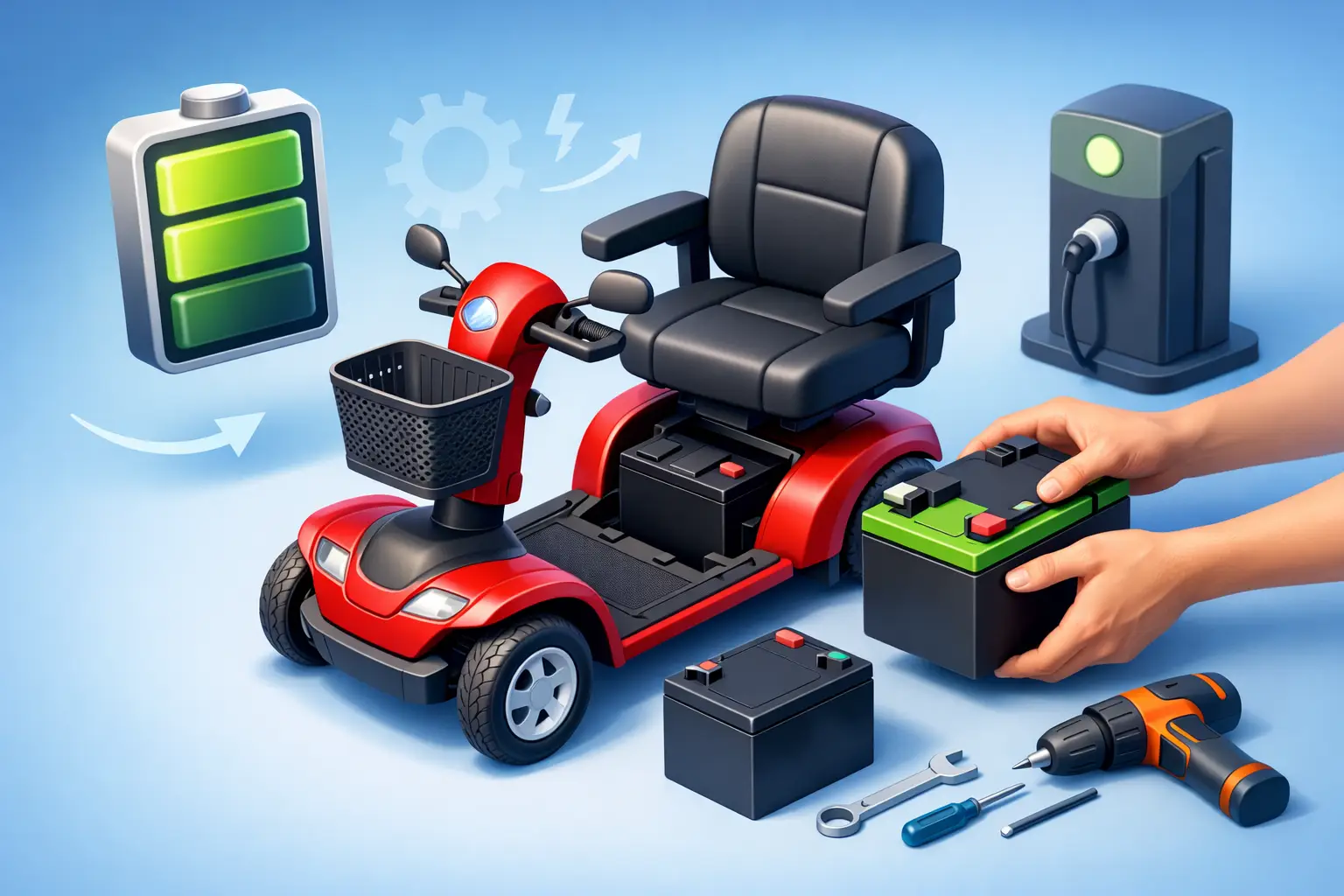
If you are comfortable with basic equipment and can safely handle the battery weight, replacement can be straightforward. Scooter batteries are still heavy, and the compartment may be awkward to access, so do not push through if lifting or bending is difficult. Ask a family member, carer, or technician for help.
First, switch the scooter off, remove the key, unplug the charger, and park on a level, dry surface. Take a clear photo of the existing cable connections before disconnecting anything. This gives you a reference when fitting the new batteries.
Disconnect the negative cable first, then the positive cable. Remove any straps or brackets and lift the old batteries out carefully, keeping them upright. Check the battery tray for corrosion, loose wiring, damaged insulation, or moisture before installing anything new.
Fit the new batteries in the correct position, reconnecting positive first and negative last. Tighten connections securely, but do not overtighten terminal bolts. Loose terminals can cause voltage drop and heat; overtightening can damage the terminal. Refit hold-down straps or brackets so the batteries cannot move while the scooter travels over bumps.
Before relying on the scooter, charge the batteries fully with a compatible charger. Then test the scooter in a safe area close to home. Watch the battery indicator, check that it accelerates normally, and make sure no warning lights appear.
Protect the New Batteries From Early Failure
The best way to get more life from new scooter batteries is simple: charge them regularly and avoid storing the scooter flat. Even when it is not being used every day, a scooter battery slowly loses charge. Leaving it discharged for weeks can cause permanent capacity loss.
For lead-acid batteries, charge after use and follow the charger instructions. Avoid repeatedly running the scooter until it stops before recharging. A full charge after a normal trip is easier on the batteries than deep discharges followed by long periods of neglect.
Store the scooter in a dry, moderate-temperature area. Extreme heat shortens battery life, while cold weather can temporarily reduce range. If the scooter is stored for an extended period, maintain the batteries as recommended by the manufacturer rather than simply parking it and hoping it starts months later.
Weight, hills, rough ground, soft grass, tire pressure, and frequent stop-start travel all affect range. If your new batteries seem to provide less distance than expected, these real-world factors may be the reason rather than a battery fault.
Get the Right Help When the Scooter Is Your Lifeline
For many people, a mobility scooter is not a convenience item. It is how they get to the pharmacy, see friends, attend appointments, and stay independent. That is why battery trouble deserves a fast, practical response instead of guesswork.
Battery Australia can help customers identify suitable mobility scooter batteries and avoid common compatibility mistakes. For customers in Brisbane, Ipswich, and the Gold Coast, service options can depend on the scooter model, battery access, and location, so it is worth having the make, model, current battery label, and charger details ready when asking for help.
Keep a note of the battery type and installation date once the replacement is complete. When range begins to drop again, you will have a clear starting point for testing and can deal with the issue before your next trip becomes uncertain.