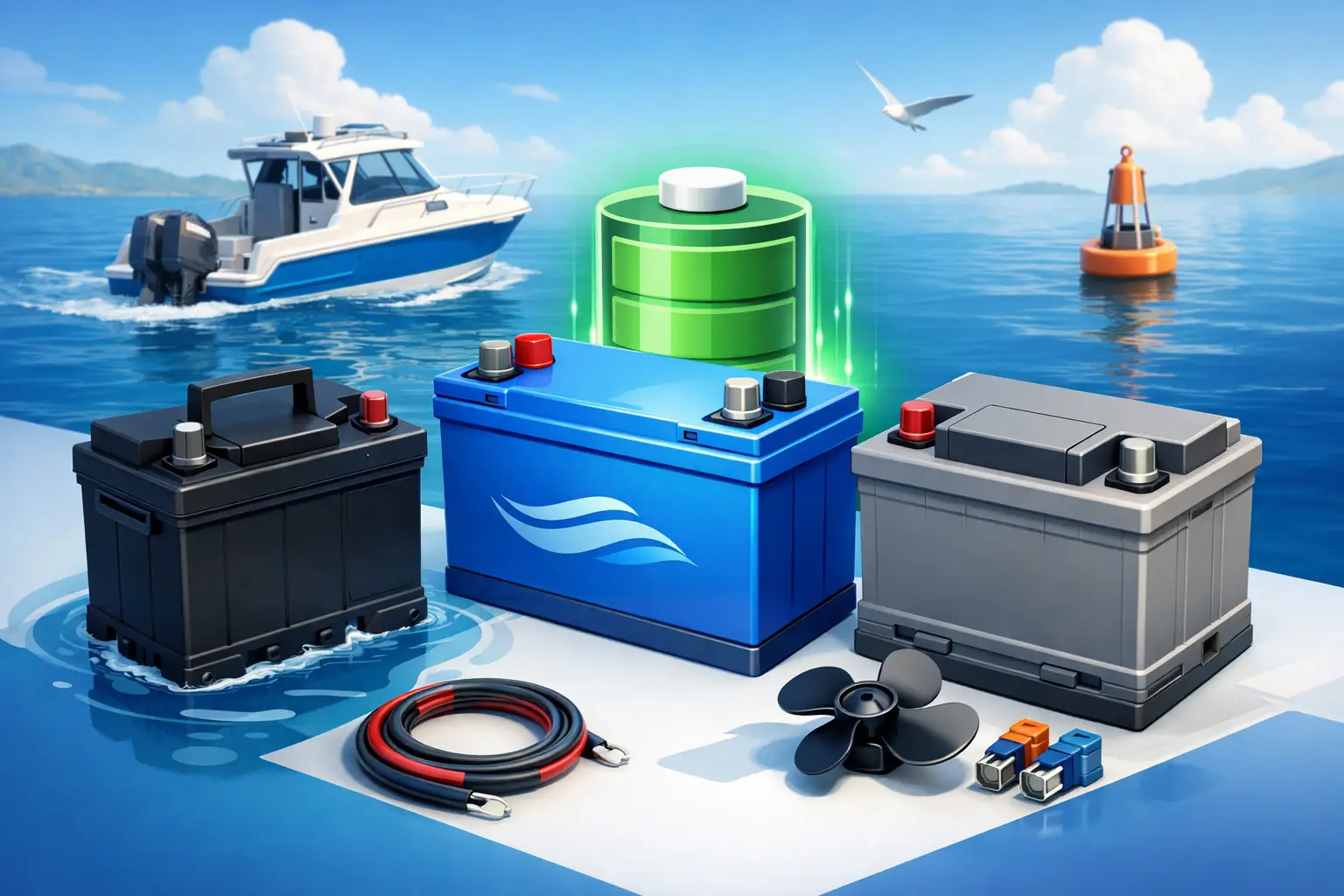
A boat battery usually fails at the worst possible moment – when the engine will not crank at the ramp, the trolling motor starts fading halfway through the day, or your electronics keep cutting out overnight. That is why choosing the best marine battery types is less about hype and more about matching the battery to the way you actually use the boat.
If you get that match wrong, you pay for it twice. First at checkout, then again in frustration when the battery life, run time, or reliability does not line up with what you expected. The right choice depends on whether you need strong starting power, steady deep-cycle performance, lower maintenance, lighter weight, or a setup that can handle all of the above.
What makes marine batteries different?
Marine batteries deal with a harder life than the average vehicle battery. They face vibration, moisture, irregular charging, and long periods of sitting idle. On many boats, one battery may be asked to crank an engine, power fish finders, run pumps, and support lights or accessories. That is a lot to ask from the wrong battery design.
The main difference comes down to how the battery is built and what job it is designed to do. Some are built for short, high-current bursts to start an engine. Others are made to deliver power gradually over a longer period and recover after repeated discharge cycles. Some can do a bit of both, but there is always a trade-off.
Best marine battery types by application
When people ask about the best marine battery types, they are usually comparing four main options: flooded lead-acid, AGM, gel, and lithium. There is also a separate question of battery purpose – starting, deep cycle, or dual purpose. You need both pieces of the puzzle.
Flooded lead-acid marine batteries
Flooded batteries are the traditional option and still a practical one for many boat owners. They are usually the most budget-friendly upfront and widely available. If you need dependable starting power and you do not mind a bit of maintenance, they can be good value.
Their downside is that they need more care. Flooded batteries can require water level checks, need to stay upright, and are less forgiving in rough marine environments. Vibration resistance is typically lower than sealed alternatives, and they do not like being deeply discharged over and over. For occasional boaters or owners focused on keeping costs down, they still make sense. For demanding use, they often fall behind.
AGM marine batteries
AGM stands for Absorbent Glass Mat, and for many boat owners this is the sweet spot. AGM batteries are sealed, spill-resistant, and better at handling vibration than standard flooded batteries. They also tend to charge faster and perform more reliably in mixed-use marine setups.
If you want a battery that works hard without much fuss, AGM is often the safe choice. It suits starting duties, deep-cycle applications, and some dual-purpose setups depending on the model. The trade-off is price. AGM costs more than flooded lead-acid, but many owners are happy to pay extra for lower maintenance and stronger durability.
Gel marine batteries
Gel batteries are another sealed lead-acid option, but they are less common in modern marine setups than AGM. They can perform well in deep-cycle use and offer good resistance to vibration. They also do not need the maintenance that flooded batteries do.
The catch is charging sensitivity. Gel batteries need the correct charging profile, and the wrong charger can shorten their life in a hurry. For that reason, they are not always the simplest choice for the average owner. If your boat and charger are already set up for gel, they can work well. If not, AGM is often the easier sealed lead-acid route.
Lithium marine batteries
Lithium, usually LiFePO4 in marine applications, has become a serious option for boat owners who want lighter weight, deeper usable capacity, and longer cycle life. A lithium battery can deliver more usable power than a similarly rated lead-acid battery because it can be discharged further without the same performance drop.
That makes lithium especially attractive for trolling motors, house loads, and electronics-heavy boats. Weight savings are another big plus. On smaller vessels, removing a lot of battery weight can make a noticeable difference.
Still, lithium is not the automatic answer for every boat. The upfront cost is much higher, and compatibility matters. Your charger, alternator setup, and battery management system all need to be considered. In some engine-starting applications, manufacturer guidance is critical. Lithium is excellent when the system is built around it. If it is not, the cheapest battery can become the most expensive mistake.
Starting, deep cycle, or dual purpose?
This is where a lot of buyers get tripped up. Battery chemistry matters, but battery role matters just as much.
Starting batteries
A starting battery is built to deliver a strong burst of power for engine cranking. It is the right choice when your main priority is reliable starts. It is not built to be heavily drained and recharged repeatedly. If you use a starting battery to run accessories for long periods, its life will usually be short.
Deep-cycle batteries
A deep-cycle battery is designed to provide steady power over time and handle repeated discharge and recharge cycles. This is the better choice for trolling motors, fish finders, onboard lighting, pumps, and house loads. If your day on the water involves electronics and accessories running for hours, deep cycle is where you should be looking.
Dual-purpose batteries
A dual-purpose battery tries to cover both jobs. For some smaller boats or simpler setups, that can be a practical compromise. It saves space and simplifies the system. But it is still a compromise. If you run a lot of accessories or depend on heavy trolling motor use, a dedicated starting battery and a separate deep-cycle bank usually deliver better results.
Which marine battery type is best for your boat?
There is no single winner because the best setup depends on how the boat is used.
For a simple runabout that mostly needs dependable engine starts, a quality flooded or AGM starting battery can do the job well. If the boat sits for stretches between uses, AGM usually has the edge because it is lower maintenance and more resilient.
For anglers using a trolling motor for long sessions, deep-cycle AGM or lithium is often the better fit. AGM is the more budget-friendly step up, while lithium offers longer run time, lighter weight, and better long-term cycle performance if the system supports it.
For boats with fridges, lights, pumps, sounders, and overnight loads, a dedicated deep-cycle house battery becomes more important than chasing the cheapest option. This is where battery capacity and discharge behavior matter more than just cranking numbers.
For smaller boats with limited battery space, a dual-purpose AGM can be a reasonable middle ground. It will not outperform a properly split system, but it can keep things simple and reliable if your power demands are modest.
The real trade-offs most buyers should know
Price matters, but so does cost over time. Flooded batteries are cheaper to buy, but they may need replacement sooner if they are worked hard or neglected. AGM costs more upfront but usually earns its keep through durability and convenience. Lithium costs the most at the start, yet can make sense for owners who use their boats often and want the longest service life with the least weight.
Charging is another big factor. Many battery problems are not battery problems at all. They are charging problems. An undercharged marine battery will lose performance fast. An incorrect charger can damage some battery types. If you are changing chemistry, especially moving to lithium or gel, your charging setup needs to be part of the conversation.
There is also the question of storage. Boats often sit idle between trips, and batteries hate that. A battery that matches your maintenance habits is usually a better buy than a technically better battery that gets neglected. If you know you want low-fuss ownership, sealed AGM or a properly managed lithium setup is often easier to live with than a flooded battery that needs regular attention.
How to make the right choice the first time
Start with the job, not the label. Ask what the battery needs to do on a normal day, not on your best-case day. Does it only need to start the engine? Is it running a trolling motor for six hours? Is it powering electronics overnight? Those answers point you toward the right battery type much faster than brand claims do.
Then check the practical details: available space, battery weight, charger compatibility, engine requirements, and how often the boat is used. A weekend fisherman and a tournament angler should not buy the same setup just because both own bass boats.
If you want the short version, AGM is often the best all-around answer for many recreational boat owners because it balances performance, durability, and ease of ownership. Flooded lead-acid still works when budget is the main concern. Lithium is the premium option when weight, cycle life, and usable capacity matter enough to justify the cost. Gel has its place, but for most buyers it is no longer the first option to consider.
A good marine battery should fit your boat, your gear, and your routine without surprises. Choose for the way you actually use the water, and you are far more likely to get a battery that starts when it should, lasts as it should, and does not leave you guessing at the ramp.