Many motorists treat every battery problem the same way. The car won’t start, so they either jump it,
ignore it, or replace it. That approach costs money, sometimes for a battery that didn’t need replacing,
sometimes by delaying a replacement that was overdue weeks ago. Understanding battery car repair, and when it’s appropriate versus a full replacement, helps avoid both of those outcomes.
A flat battery is not automatically a dead battery. And a dead battery is not automatically beyond fixing.The difference matters because the right response to a corroded terminal clamp is not the same as the right response to an internally failed cell. Getting that distinction wrong costs you time, money, or both.
This article covers how to diagnose what’s actually wrong, what to do safely at the roadside, what
replacement realistically costs across different vehicle types in Brisbane and across Australia, and how to choose a service that comes to you rather than making you tow the car somewhere. Battery Australia operates 24/7 across Brisbane and surrounding suburbs, handling both scenarios, but before you call
anyone, it helps to know what you’re actually dealing with.
What car battery repair actually covers
The term “battery repair” is used loosely, and that looseness creates confusion. Some fixes are genuine
and worth doing. Many services labelled as battery car repair are, in practice, replacements in disguise.
Corroded terminals with blue-green or white residue are a real and fixable problem. Cleaning them with a baking-soda solution and a wire brush is often a short job of around ten minutes and can restore function if the battery is otherwise healthy. A loose or broken terminal clamp is similarly cheap to address. Neither of these problems means the battery itself has failed.
A discharged battery, one that’s been drained flat by a door light left on overnight, is not a failed battery. If it load-tests well after a proper slow charge, the battery has years of life left. The fix is the charge itself, not a replacement. Replacing a battery that simply ran flat is one of the most common and unnecessary expenses motorists make.
Internal cell failure, permanent sulphation, a swollen or cracked case, and electrolyte leakage are different entirely. These are not fixable problems. No amount of charging or terminal cleaning recovers a battery with physical damage or cells that no longer hold voltage. The line is clear: a battery that won’t hold charge after a full recharge has failed internally. A battery that simply ran flat and load-tests fine has not.
One needs replacing; the other needs a charger.
It’s also worth understanding the battery type in your vehicle. Sealed maintenance-free batteries, AGM
units, and EFB batteries used in stop-start vehicles cannot be topped up with distilled water or serviced in the traditional sense. When they fail, they’re replaced. There is no in-between option for these types, which makes the diagnostic step more important, not less.
Reading the symptoms: repair or replace?
Voltage checks
A basic multimeter is all you need for a first assessment. A resting voltage of 12.6V or above means the
battery is fully charged. Readings around 12.2 to 12.3V indicate a weak or partially charged battery. If the voltage reads fine at rest but drops sharply when you try to crank the engine, the battery is likely failing under load. A healthy battery under cranking load should not drop below 9.6V; anything lower points to
replacement, not a recharge.
Load tests and slow cranking
Slow cranking, especially in mild temperatures, is one of the most consistent and overlooked symptoms.
It’s not just an annoyance; it’s the battery working harder than it should to deliver the same starting
current. That extra effort signals that capacity is shrinking. Drivers may notice it for weeks before acting
on it.
Alternator checks
Separating a battery fault from an alternator problem is straightforward if you know what to test. Charge the battery fully, disconnect it overnight, then retest voltage in the morning. If it’s still strong, the battery isn’t the problem. With the engine running, a healthy charging system produces between 13.8V and 14.4V at the battery terminals. Consistently lower than that, and the alternator is likely undercharging. Replacing a battery won’t fix an alternator fault, and that’s an expensive mistake to make twice.
Some symptoms point directly to replacement and shouldn’t be second-guessed:
Repeated jump-start dependence across multiple days
Arotten-egg or sulphur smellnear the battery
A visibly swollen, bulging, or cracked case
A battery warning light that stays on after the engine starts
These are not repair signals. They’re replacement signals. Trust them and act on them.
What to do at the roadside before help arrives Before connecting anything, check the battery visually. If the case is cracked, bulging, or leaking, do not attempt a jump-start under any circumstances. Keep clear of the battery and call for professional assistance. A damaged battery can vent explosive hydrogen gas and requires careful handling.
For a safe jump-start on a standard vehicle, the connection order matters. Connect red to the positive
terminal of the dead battery first, then red to the positive of the donor battery. Connect black to the
negative of the donor battery, then the final black clamp to an unpainted metal point on the engine block of the dead vehicle, not the battery terminal itself. Start the donor vehicle, wait a minute, then try to start the dead one. Disconnect in the exact reverse order once the engine is running.
Drive for at least 20 minutes afterward. The alternator needs time to recharge the battery, and a fiveminute idle around the block won’t do it. If the battery can’t hold that charge after a proper drive, it needs testing or replacing.
Modern vehicles with AGM or stop-start technology require more care than older vehicles. Some
manufacturers recommend against jump-starting entirely and advise using a battery support unit instead.
If your vehicle handbook specifies this, follow it. When in doubt, call a mobile battery technician rather
than risk damaging the vehicle’s electronics. The cost of getting it wrong on a modern vehicle with a
complex electrical system far outweighs the cost of a call-out.
Car Battery repair vs Car Battery replacement: what you’ll pay in Brisbane and across Australia
Pricing varies by vehicle type, battery technology, and whether you’re buying the battery alone or paying for supply and installation together. A price quoted for the battery alone is not a complete comparison.
For most small passenger cars, expect installed costs of $150 to $250 for a standard replacement
battery. Mid-size SUVs and vehicles requiring AGM or EFB batteries typically land in the $200 to $400
range. Diesel vehicles and large 4WDs often sit at $280 to $400 or more, particularly when the battery
type requires ECU registration after fitting. Hybrid vehicles need their 12V auxiliary battery replaced
separately from the main traction battery, with fitted costs generally between $200 and $450.
A transparent quote covers the battery itself, professional installation at your location, removal and
recycling of the old battery, a charging system check to confirm the alternator is healthy, and a warranty on the new battery. If any of these are absent from the quote, ask why. Upfront, all-in pricing removes the risk of unexpected charges once the technician arrives.
On warranties: leading brands sold in Australia typically offer 24 to 40 months coverage depending on the product tier. Century’s Hi Performance range carries 30 months; its Ultra Hi Performance carries 40.
Delkor covers standard passenger car batteries for 36 months; Optima products typically carry up to 36 months as well. A warranty should cover manufacturing defects, not damage from neglect or incorrect fitment. Always ask for the warranty documentation at the time of installation, and don’t accept a verbal assurance in its place.
Mobile fitting versus a workshop visit
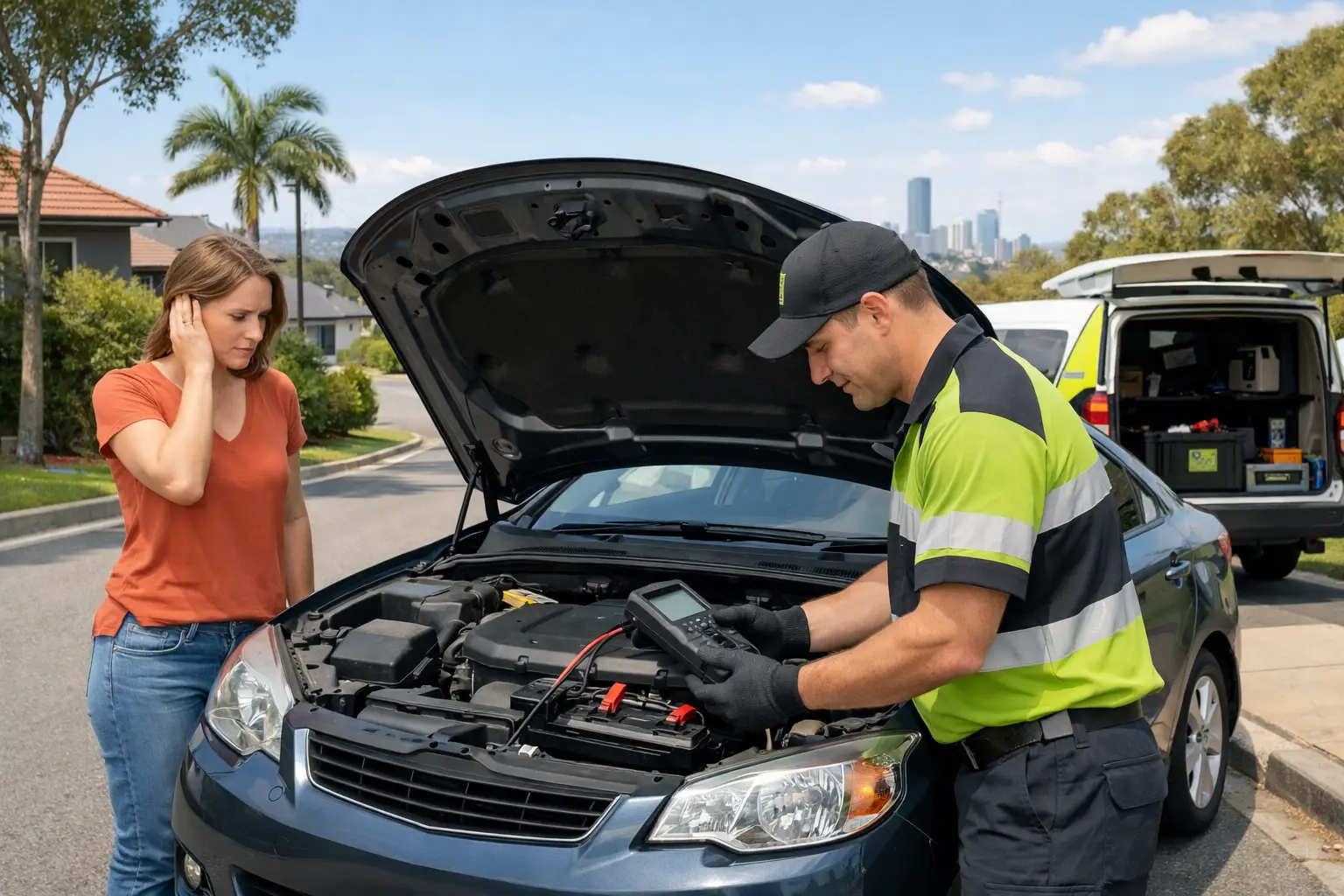
A flat battery usually happens in a carpark, a driveway, or at the side of the road. Towing a car to a
workshop to have a battery fitted adds cost and delay to a problem that can often be solved on the spot in around 30 minutes for a standard passenger car. Mobile battery fitting exists precisely because the job doesn’t require a hoist, a service bay, or any specialist workshop infrastructure. The technician arrives
with the right battery, fits it, tests the charging system, and handles disposal. That’s the entire job done at your location.
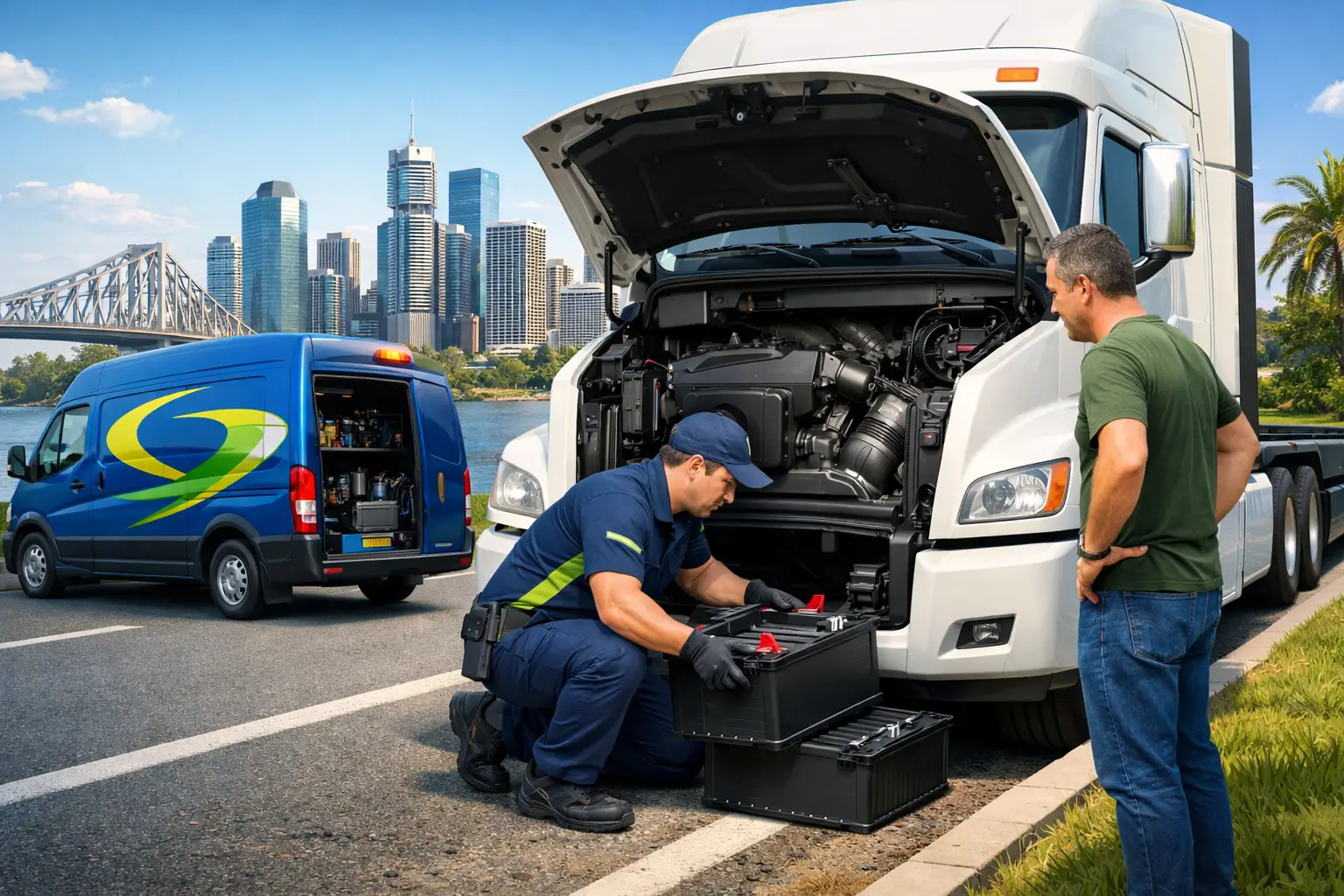
For commercial fleets and taxi operators, the calculation is even clearer. Every hour a vehicle is off the
road has a direct dollar value. A mobile technician who arrives promptly and fits a battery on-site costs far less than a tow, a workshop queue, and a missed job. Waiting until a vehicle won’t start is the most
expensive way to manage a fleet. A simple log of installation dates by vehicle, combined with annual load testing for anything over two years old, catches most failures before they happen.
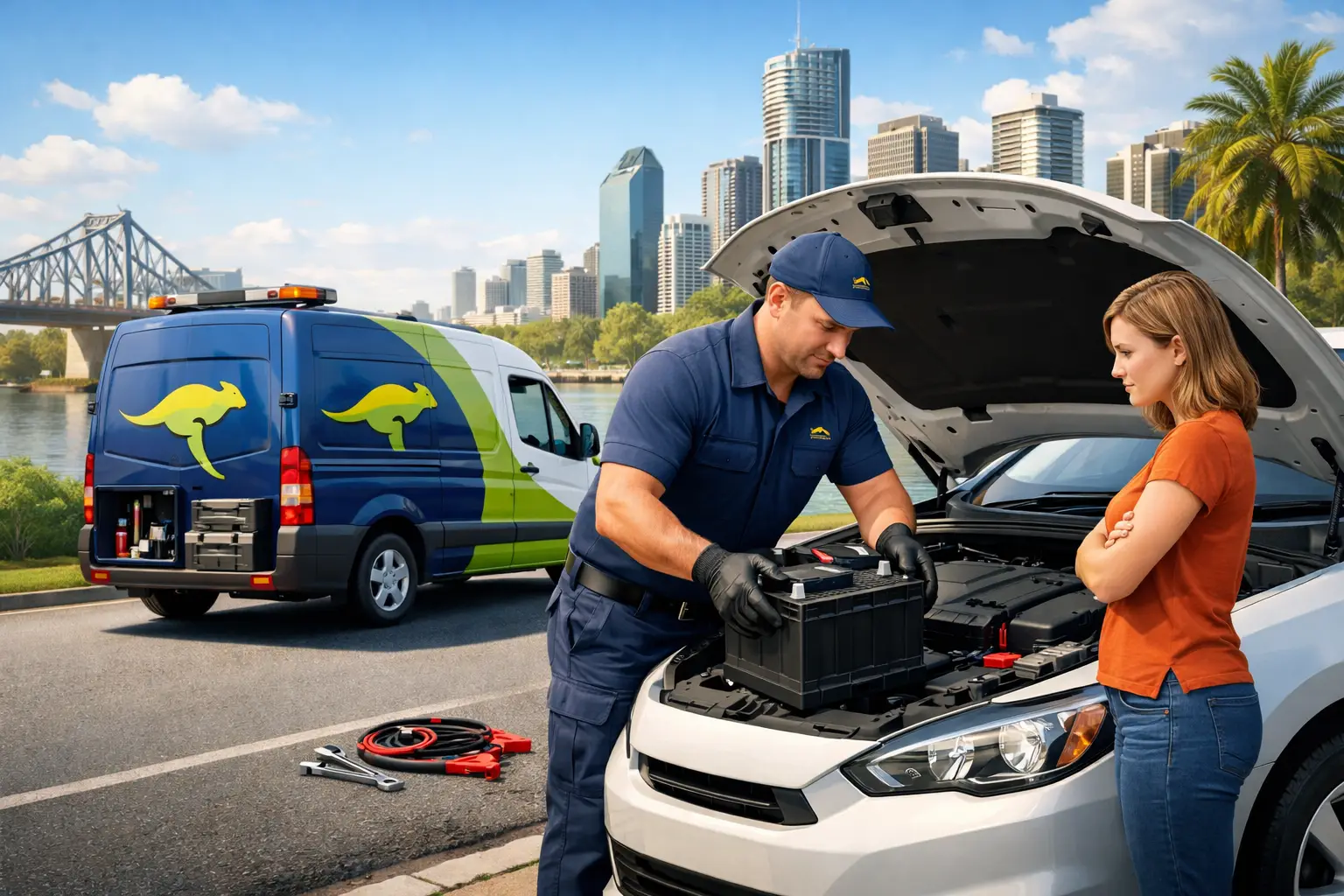
Battery Australia operates across Brisbane and surrounding suburbs around the clock, with a 30-minute response target and no membership required to call them out. They stock a full range of premium brands including Century, Delkor, Optima, and VARTA, covering passenger cars, SUVs, diesels, 4WDs, motorcycles, boats, caravans, and specialist equipment including mobility scooters, golf carts, and solar systems. Every job comes with upfront pricing before the technician arrives and a warranty on the battery fitted.
For fleet operators, Battery Australia supports commercial accounts and regular servicing arrangements, which removes the scramble of finding a provider every time a vehicle goes down. Get in touch with the Battery Australia team directly for a quote before you commit to anything.
Battery disposal: what the rules actually require Lead-acid batteries are classified as hazardous waste in Australia and cannot go into general household rubbish or a skip bin. In Victoria they’re classified as reportable priority waste. In New South Wales, transporting loads over 200kg requires an EPA licence. Across the ACT, Queensland, and other states, the same core rule applies: they must be returned to a retailer, a battery recycler, a service provider, or a council waste transfer station that handles them correctly.
A proper mobile or workshop replacement service removes the old battery and disposes of it responsibly as part of the job. It’s the correct process, and if a provider doesn’t mention disposal, ask directly. A technician who leaves an old battery with you is handing you a legal and environmental responsibility that should be theirs to manage.
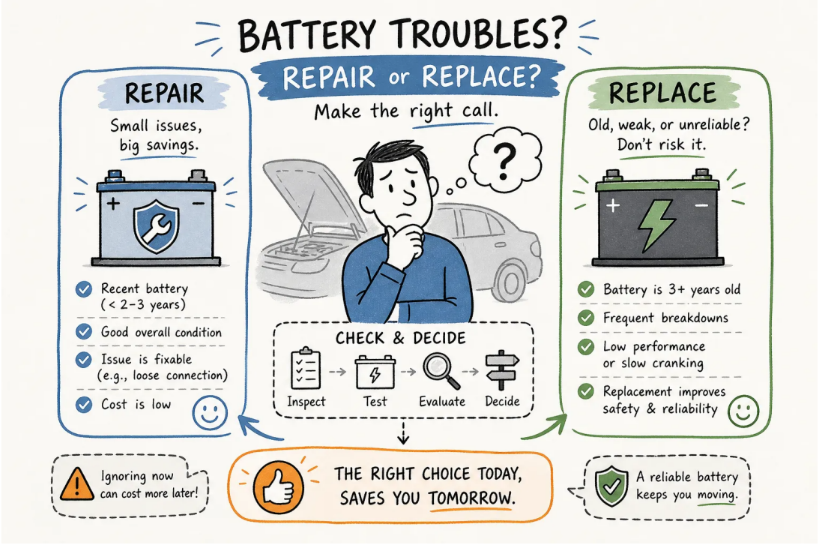
The decision comes down to one test
Charge the battery fully, then load-test it. If it holds voltage and delivers current above 9.6V under load, it’s fine. If it doesn’t, it needs replacing. No amount of cleaning, charging, or wishful thinking changes that
outcome. The test is simple, the result is definitive, and acting on it quickly saves money and the
inconvenience of being stranded.
For motorists in Brisbane, the most practical path for battery car repair or replacement is a mobile battery service that brings the right battery to you, fits it on the spot, handles disposal, and backs it with a
warranty. Battery Australia does exactly that, any time of day or night, with upfront pricing and no
membership required. Contact the team for a quote and they’ll give you a straight answer on cost before anyone shows up at your door.
Know the symptoms, trust the test results, and don’t pay to replace something that didn’t need replacing.